


How did Mona Lisa get so famous?
- Aniket Kumar
- Mar 17, 2021
- 3 min read

Updated: Apr 9, 2021
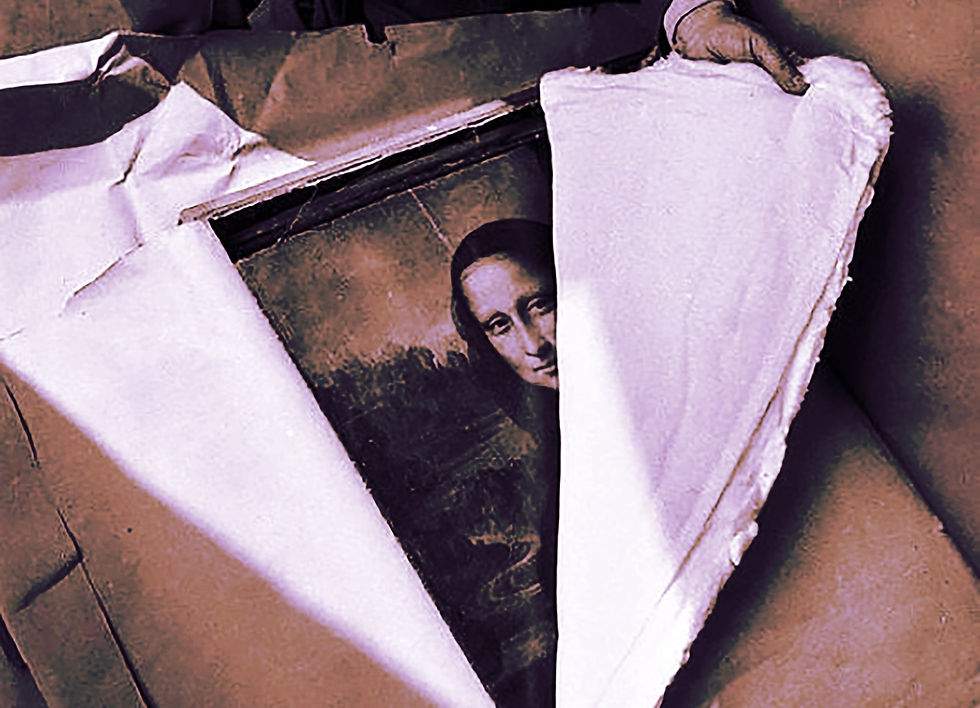
Mona Lisa might be the reason why most of us know about the great painter, Leonardo da Vinci. Painted in 1507, Mona Lisa is considered to be an archetypal masterpiece of the Italian Renaissance. It has been described as "the best known, the most visited, the most written about, the most sung about, the most parodied work of art in the world". But, the reason for its insurmountable fame is not the fact that it was painted by the great Leonardo Da Vinci or its enthralling beauty, It is because the human brain is hard-wired to be lazy.
From 1507-1911, Mona Lisa was relatively unknown. It was so unknown, that when it was stolen from Louvre, For two days nobody even noticed that it was missing from the museum. But, then the newspaper articles about the theft transformed it into a sensation. Even Pablo Picasso, the famous Spanish painter, was a suspect in this investigation at one point.
After a rigorous investigation of two years, it was found out that the real culprit was a Louvre employee, who was an Italian patriot and believed that Leonardo's artwork belonged in an Italian Museum.
The painting was back in Louvre by January 1914 and the crowd to see the stolen painting was unbelievable. The media sensation was so huge that not only it garnered fame around the world but it also became a target for continuous attempts of thefts and vandalism throughout history.
Currently, The Mona Lisa is one of the most valuable paintings in the world. It holds the Guinness World Record for the highest known insurance valuation in history at US$100 million in 1962 (equivalent to $660 million in 2019).
But most of us don't know about this theft incident, then why is it still so famous?
Because it is a human tendency to value what is familiar and Mona Lisa became familiar to the world through this incident. It suddenly became the most famous work of Leonardo da Vinci and is one of the most prized possession of the French.
It has been 107 years since the recovery of The Mona Lisa and its fame has increased at an exponential rate throughout the century.
This is called the Mere-exposure effect, a psychological phenomenon by which people tend to develop a preference for things merely because they are familiar with them.
As I said earlier that our brain is hard-wired to be lazy and it takes our brain a lot of energy to make difficult decisions. So, it looks for ways to cut corners by defaulting to what it already knows. We experience this in our everyday life.
For example, You have probably had the experience of hearing a new song and not caring for it much at first, but after hearing it several times, you find that you do enjoy the song and catch yourself humming it when you least expect to.
Also, many stock traders tend to invest in securities of domestic companies merely because they are more familiar with them, even though international markets offer similar or better alternatives. One of my favorite demonstrations of this effect comes from a 1992 study. The researchers arranged for four different women (of similar appearance) to attend a college class a certain number of times throughout the semester. One of these women didn’t actually attend at all, one attended five times, one attended ten times, and the last woman attended fifteen times. These women didn’t interact with the students at all; they just sat in on the lecture.
At the end of the semester, the students in the class saw pictures of each of the women and rated them on several scales like physical attractiveness. Despite never having interacted with these women, the students showed a clear mere exposure effect. That is, they evaluated the woman who they had seen 15 times much more positively than the woman they hadn’t seen at all.
So, it might be profitable for us to go against the nature of our brain and think about the alternative option every now and then.
Hence, Embrace the unfamiliar.


Comments